Apr 27, 2026
Blended Winglets Save Time, Produce ROI
What’s the ROI on a set of Blended Winglets? It’s a question commonly asked by aircraft operators as they consider the ultimate upgrade for their jet, usually framed within the context of fuel savings alone.
While fuel savings are apparent with winglet-equipped aircraft as compared to their straight wing counterparts, business jets simply aren’t flown often enough to recuperate the costs, but they do provide ROI in other ways.
When Aviation Partners first set out to equip a set of Blended Winglets on the Gulfstream GII in the early 1990s, business jet operators cared about performance and range – with an interest in aesthetics of course. How could they optimize their aircraft to perform as good or even exceed other options on the marketplace for a fraction of the cost?
This was the question Dennis Washington pondered. Blended Winglets was the solution Joe Clark and the Aviation Partners “dream team” presented. Rapidly gaining popularity, over 70% of the available Gulfstream GII fleet found itself flying with a set.
Airliners fly an average of 3,000 to 4,000 hours in a given year as opposed to business or private jets averaging around 10 percent of that.[1] Factor in that airlines have full fleets whereas business jet operators typically only have one aircraft, or in a few cases perhaps 2-3, the numbers start to look drastically different.
Knowing that winglets typically provide 5% to 7% fuel savings on any given leg, airlines saw substantially increased margins given the scale of their operations. Business jet owners, despite their significantly reduced flying on entirely different types of missions, sought and discovered different ways winglets provided ROI, aside from measurable fuel savings.
Where Blended Winglets Produce ROI
Any responsible jet owner has their aircraft on an engine program. Designed to mitigate, engine programs act as an insurance policy, covering the costs of routine maintenance, repairs and overhauls, helping owners manage expenses and ensure engine reliability. Engine programs are billed dependent on the number of hours an aircraft flies on a given year.
Engine program providers vary dependent on the engine manufacturer and lifecycle stage of the airframe. Let’s take for example a Falcon 900EX. Equipped with three Honeywell TFE731-60s, it’s a prime candidate for Honeywell’s MSP Gold program. Alternatively, take for example a Falcon 2000EX. Equipped with two Pratt and Whitney PW308Cs, it’s well suited for the Pratt and Whitney ESP program, or third-party options.
For the sake of simplicity, an operator may plan for about $550/hr on average should they decide to enroll in any of the above options. Using the Falcon 900EX with its three engines as an example, that is roughly $1,650/hr of operating expenses.
Among the benefits Blended Winglets offer, it’s reduced drag. Flights that had to be done at cruise profiles at long-range cruise are now possible at M.84. That’s less time in the air and fewer engine hours.
Take one popular route as an example: Van Nuys, CA, to Teterboro, NJ. The Falcon 900EX in this scenario has the mission profile of a 2,600 pound payload during the winter months, in both M.80 (cruise before winglets) and M.84 (cruise after winglets).
Here’s how the respective cruise profiles stack up:
- At M.80, an estimated flight time enroute of 4 hours and 11 minutes.
- At M.84, an estimated flight time enroute of 4 hours and 2 minutes.[2]
If this airplane flew at M.84 as opposed to M.80, it’d shave off 9 minutes on each leg. In just six legs, the savings would compound to just over an hour of total flight time – saving $1,650 from the operating costs on just the engine programs alone.
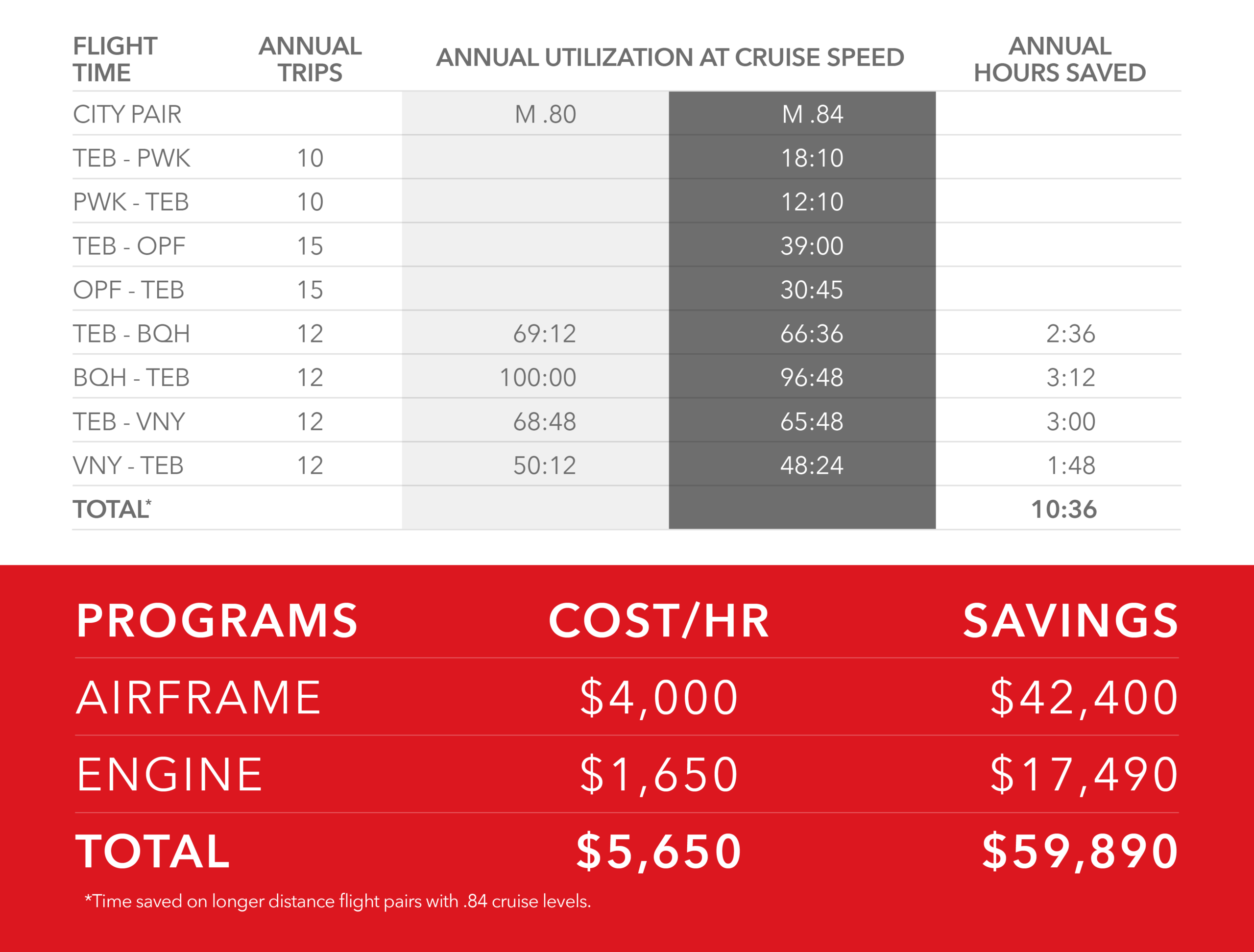
To better illustrate that saving, see how a hypothetical flight department performs with typical mission profiles utilizing a winglet-enhanced Falcon 900EX.
Another hourly cost to consider is airframe care. Similar to an engine maintenance program, these programs are designed to protect the airframe for scheduled/unscheduled maintenance, replacement of parts and other encounters the operator may experience. A popular choice for Falcon operators is the OEM option, FalconCare, offering several tiers and billing options entailing per flight hour, per cycle or per month. Third party options for those operating Hawker airframes or legacy aircraft include JSSI.
While pricing varies, the conclusion is the same: Less time on the airframe leads to greater savings. Winglets also eliminate fuel stops, lowering cycles in the process.
If our example Falcon 900EX were enrolled in FalconCare at a cost of $4,000 per hour, that brings us to roughly $5,650 saved in engine and airframe costs only on these Van Nuys-Teterboro trip segments.
The longer the flights, the greater the savings. Flying popular routes – including cross-country or trans-Atlantic longer examples to reach the average 400 annual flight hours, Falcon 900EX owners could save nearly 11 hours of operation – equating to over $59,000 in program savings. With operating costs lowered coupled with a jet flying at enhanced performance, Blended Winglets optimize the aircraft for a fraction of the price.
While this case study highlights typical aircraft use and hours flying between popular city-pairs, we can use your specific mission profile and engine/airframe hourly costs to show exactly how much time and cost savings can be achieved by flying longer trips faster.
Aviation Partners is ready to schedule your installation. Please call us at 1-800-WINGLET or email us at sales@winglets.com to get the conversation started.
[1] How Many Hours a Year Do Private Jets Fly
[2] Flight performance calculations were derived through ForeFlight’s Mission Planning Analysis software.